
From San Antonio to Iwo Jima
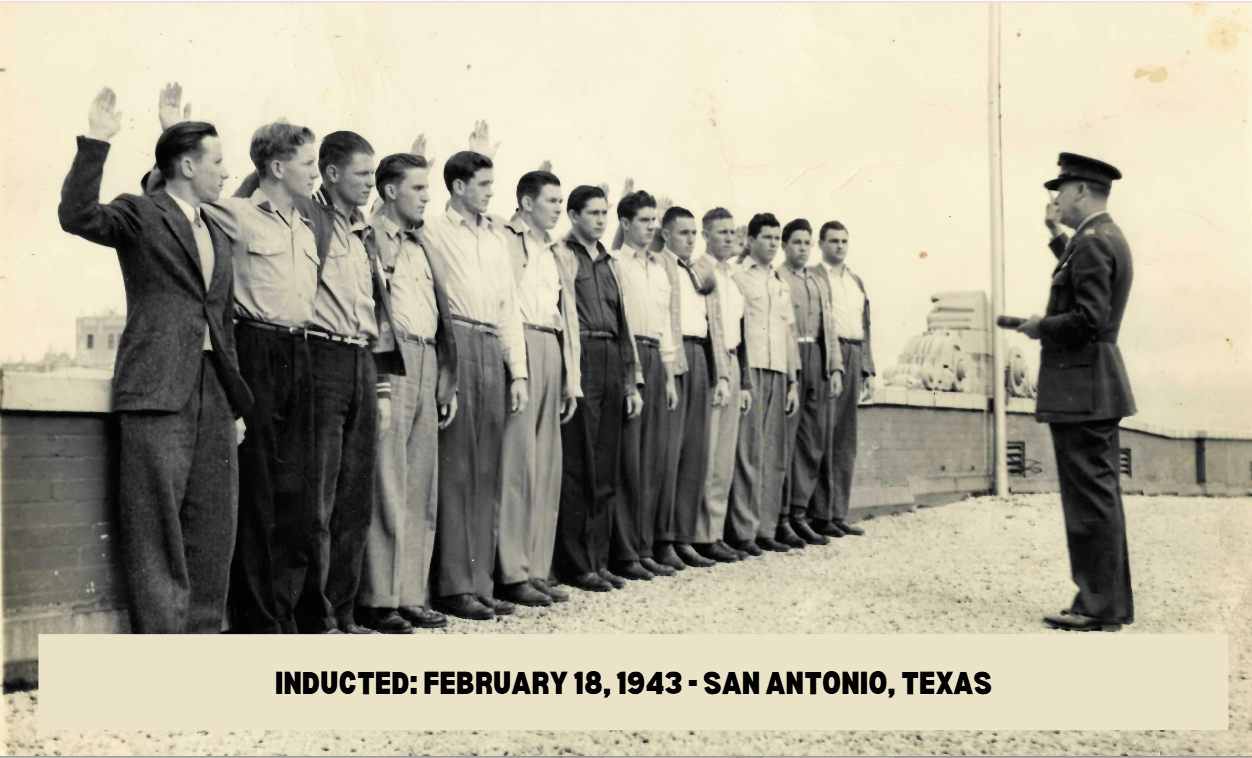
Induction Picture of 13 young men and teenagers to the U.S. Marine Corps on the roof of 118 Broadway, San Antonio, Texas on February 18, 1943. Photograph:
By Dennis R Blocker II
During World War II, the historic Bedell (now Ayers) Building at 118 Broadway, San Antonio, Texas, served as the headquarters of the United States Marine Corps Southern Recruiting Division, District of San Antonio. Within its walls, young men from across nearly 60, 000 square miles of South Texas -- whether from bustling cities or small rural town came to be inducted into the Marine Corps.
For South Texas recruits, the journey to becoming a Marine began here. Buses carried young men from cities and towns like Sabinal, Uvalde, McAllen, Weslaco, Del Rio, Leakey, Pleasanton, Comfort, Fredericksburg, and many others into the big city for processing. On the sixth floor, the recruits underwent detailed medical examinations of the entire body, and completed stacks of paperwork covering payroll, life insurance, and benefits. They moved from office to office, fulfilling tasks and answering questions about their education, occupations, and even hobbies.
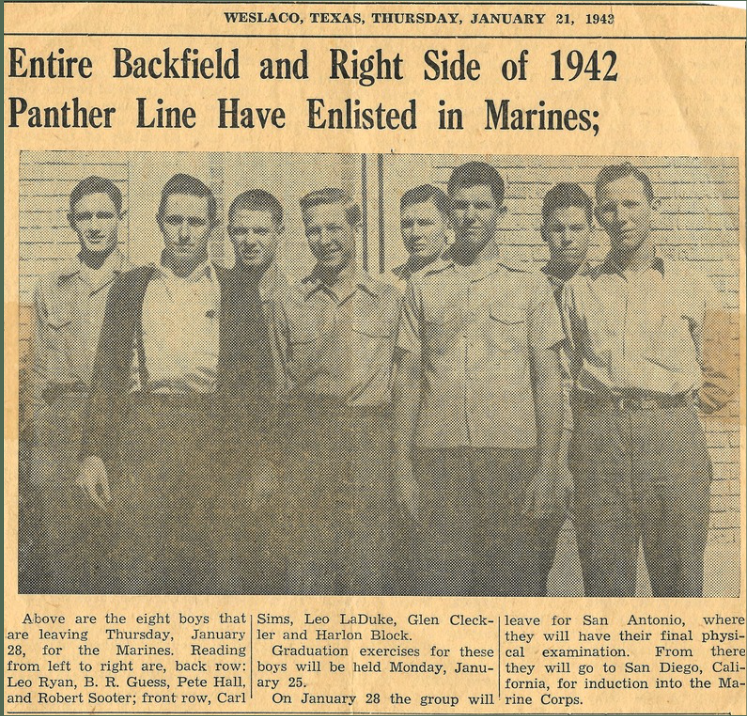
Newspaper article featuring the Weslaco Eight, from the newspaper the Valley Morning Star, January 28, 1943.
By February 18, 1943, this process had become a well-oiled machine. That Thursday, however, stood apart: among the recruits were eight members of the 1 942 Weslaco High School senior class, seven of whom were on the football team. Their pledge to enlist together upon graduation had drawn widespread publicity in the Rio Grande Valley. A January 28, 1 943, article in the Valley Morning Star of Harlingen featured their photo and announced their upcoming departure for San Antonio.
The gravity of their decision was not lost on their families or communities. Parents, teachers, pastors, and neighbors understood that these young men who barely out of high school were likely heading into mortal danger. In January 1943, the outcome of the war was far from certain; Guadalcanal was only just concluding, and the fiercest battles still lay ahead: Tarawa, Cape Gloucester, Bougainville, Kwajalein, Eniwetok, Saipan, Guam, Tinian, Peleliu, Iwo Jima, and Okinawa. Recognizing the risk, South Texas communities honored the boys with farewell dinners, toasting their courage while quietly fearing for their safety.
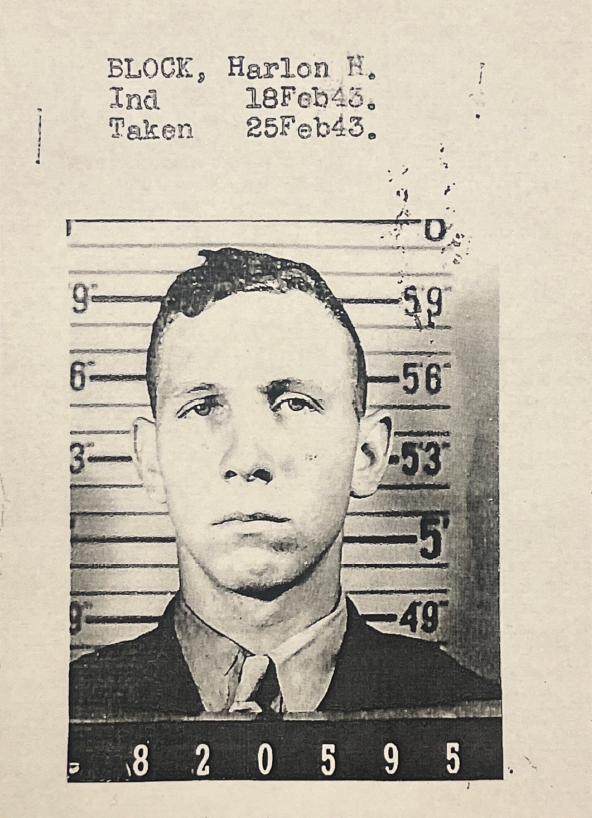
Marine Corps recruit photo of Harlon Block taken on February 23, 1943. Photo: National Archives
NAID: 405189314
In San Antonio, the final step of induction brought these young men to the roof of the Bedell Building. There, beside the flagpole, they raised their right hands as Marine Captain Donald M. Taft, the commander of the station, held a Bible in his left hand and raised his right. Then and there the new recruits swore an oath to defend the Constitution and the United States against all enemies. A photographer captured the moment forever: thirteen young men standing in solemn pledge. Among them was Harlon Henry Block, one of the Weslaco Eight, fourth from the right.
Just two years later, on February 23, 1945, Corporal Harlon Block would take part in one of the most iconic moments in American history: the second flag-raising atop Mount Suribachi during the Battle of Iwo Jima. In Joe Rosenthal’s photograph, Block is first from the right. The image went on to become the most reproduced war photograph in U. S. history, appearing on stamps, posters, memorials, sculptures, coins, and countless keepsakes. Its endurance testifies to the lasting power of that moment.
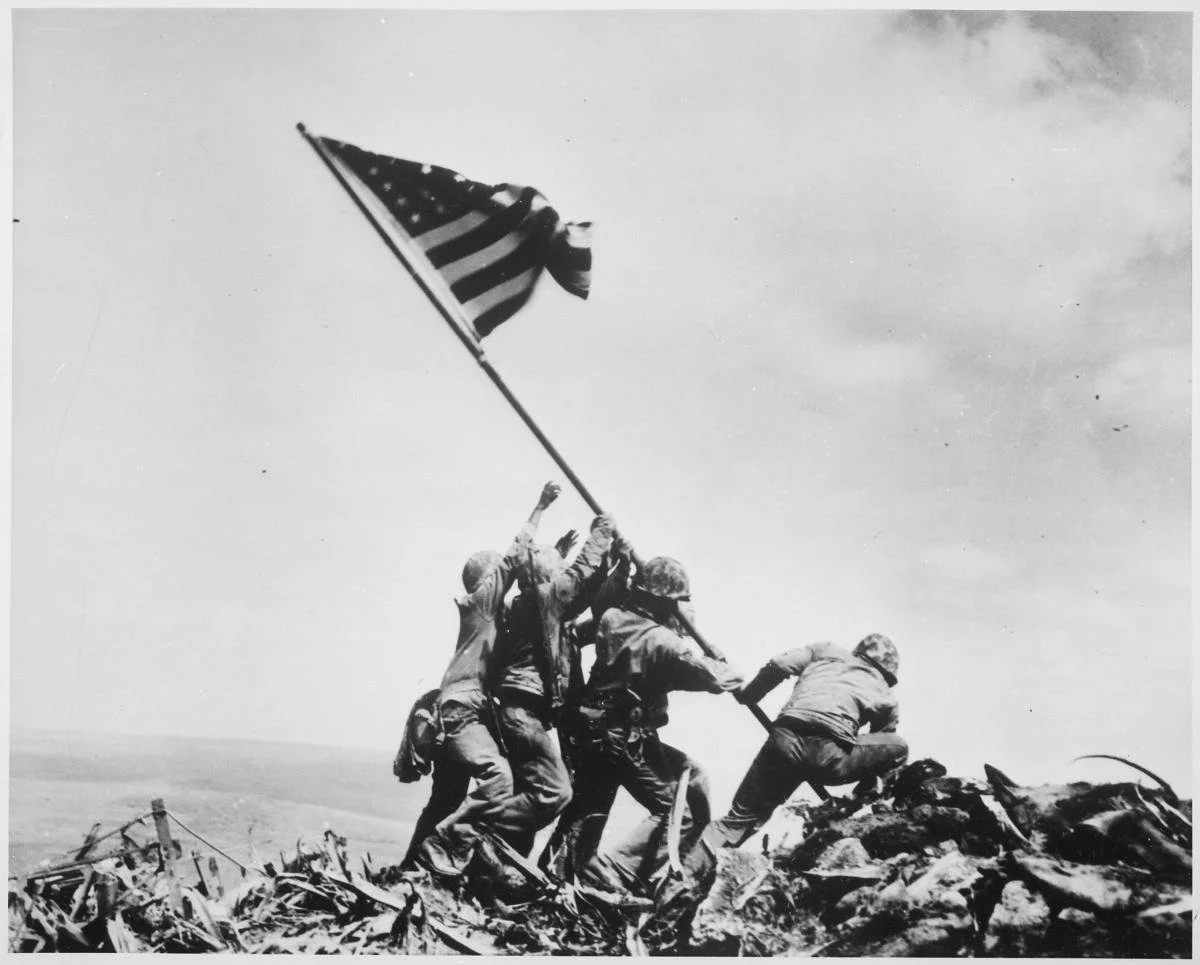
Photograph of Flag Raising on Iwo Jima; 2/23/1945. Photograph: General Records of the Department of the Navy, NAIDA 520748
It is remarkable to reflect on the connection between a rooftop in San Antonio and a volcanic mountaintop half a world away. The young men who raised their hands in pledge at 1 1 8 Broadway could not have foreseen the paths awaiting them. This site stands today not only as a reminder of the bravery of the Weslaco Eight, but also as a testament to the thousands of South Texans who began their journey as Marines in this very building, answering the call to defend freedom.
The Weslaco Eight were:
Edward Herman "Pete" Hall - Fought at Tarawa, Saipan, Tinian and Okinawa.
Earnest Leo Ryan - Served on Johnston Island.
James Glen Cleckler - Served at Majuro Atoll and fought at Iwo Jima.
Henry Carl Sims - Fought at Guam and Iwo Jima.
Leo Hathaway LaDuke - Served at Majuro Atoll.
Robert Lee Sooter - Fought at Saipan where he was wounded in action, fought at Tinian and Okinawa. His older brother was killed at Pearl Harbor on the USS Arizona.
Benjamin Reynolds Guess Jr.- Fought at Tarawa where he was wounded in action. He subsequently fought at Saipan, Tinian, and Okinawa.
Harlon Henry Block - Fought at Bougainville, and Iwo Jima where he raised the flag on Mt. Suribachi on 23 February 1 945 and then was killed in action on 1 March 1 945.
Learn about OHP’s Local Markers Program, which includes the History Here program, and watch all episodes of There’s A Story Here.
OHP will share photos of you with the marker if you tag @SAPreservation on social media!